|
Peroxisome proliferator-activated receptors (PPARs) are members of the nuclear hormone receptor superfamily that modulate target gene expression in response to fatty acid ligands. All three PPAR subtypes (PPARα, PPARβ/δ and PPARγ) activate their target genes through binding to specific DNA elements (PPREs) as heterodimers with the retinoid X receptor (RXR). PPARs can also regulate genes by directly interacting with specific transcription factors, but the underlying mechanisms are not well understood.
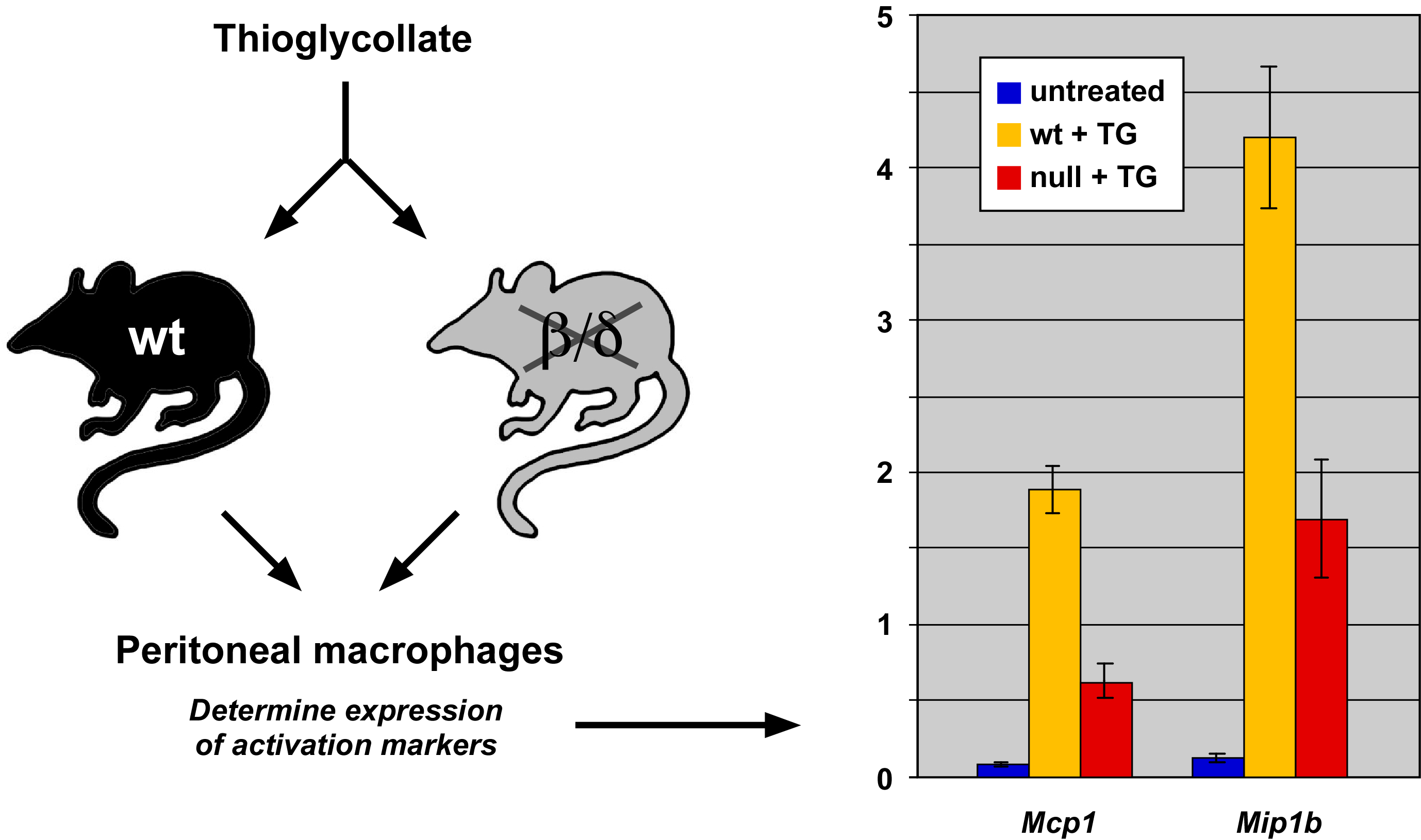
PPARβ/δ has a critical role in modulating lipid catabolism, glucose homeostasis and inflammation. Consistent with its function in the regulation of cell differentiation and proliferation, PPARβ/δ has been implicated in tumorigenesis. We have recently shown that the growth of syngeneic Pparb wild-type tumors is severely impaired in Pparb null mice concomitant with a severely altered, hyperplastic tumor stroma. This phenotype apparently arises from the hyperproliferation of endothelial cells and a lack of microvessel maturation differentiation specifically in the inflammatory tumor stroma. Furthermore, we and others have shown that the activation of macrophage in vivo is perturbed in a Pparb background (see Figure). In addition, we have strong experimental evidence for a functionally essential cross-talk of PPARβ/δ and PPARγ in macrophage activation.
Currently, it is largely unclear which genes are regulated by PPARβ/δ and represent critical targets in inflammatory cells. In addition, the molecular mechanisms involved in the interplay of PPARβ/δ and PPARγ are not understood. A main goal of this project is to investigate these questions by combining knockout mouse and genomics technologies, in particular microarrays, chromatin immune precipitation and ChIP-Seq. Based on the results of these studies we will study the chromatin structure of select PPARβ/δ target genes with a focus on how PPARβ and its ligands modulate the assembly and dynamics of PPARβ/δ transcription complexes.
References:
Müller, R., Kömhoff, M., Peters, J.M. and Müller-Brüsselbach, S. (2008). A role for PPARβ/δ in tumor stroma and tumorigenesis. PPAR Res. 2008:534294.
Rieck, M., Meissner, W., Ries, S., Müller-Brüsselbach, S. and Müller, R. (2008). Ligand-mediated regulation of PPARβ/δ: A comparative analysis of PPAR-selective agonists and all-trans retinoic acid (atRA). Mol Pharm. 74: 1269-1277.
Müller, R., Rieck, M. and Müller-Brüsselbach, S. (2008). Regulation of cell proliferation and differentiation by PPARβ/δ. PPAR Res. 2008:614852.
Müller-Brüsselbach, S., Kömhoff, M., Rieck, M., Meissner, W., Kaddatz, K., Adamkiewicz, J., Keil, B., Klose, K.J., Moll, R., Burdick, A.D., Peters, J.M. and Müller, R. (2007). Deregulation of tumor angiogenesis and blockade of tumor growth in PPARβ deficient mice. EMBO J. 26: 3686-3698.
Adamkiewicz, J., Kaddatz, K., Rieck, M., Wilke, B., Müller-Brüsselbach, S. and Müller, R. (2007). Proteomic profile of mouse fibroblasts with a targeted disruption of the peroxisome proliferator activated receptor-β/δ gene. Proteomics. 7: 1208-1216.
|