
A2: Role of Nerve growth factor (NGF) for tumor growth and angiogenesis in a mouse model of lung carcinoma


Prof. Dr. Harald Renz
PD Dr. Andreas Nockher
Abt. für Klinische Chemie & Mol. Diagnostik
Baldingerstraße
35043 Marburg
Phone: 49-6421-28 66235
Fax: 49-6421-28 65594
Homepage: Zentrallabor
Cooperation within LOEWE
B1 - Ellenrieder
B3 - Müller
Graduate student

Katrin Seidler
Abt. für Klinische Chemie & Molekulare Diagnostik (BMFZ)
Hans-Meerwein-Str. 2
35043 Marburg
Abt. für Klinische Chemie & Molekulare Diagnostik (BMFZ)
Hans-Meerwein-Str. 2
35043 Marburg
Fax: 06421 28 66086
Personal advisory board: Renz, Nockher, Müller, Konur
| A2: Role of Nerve growth factor (NGF) for tumor growth and angiogenesis in a mouse model of lung carcinoma |
|
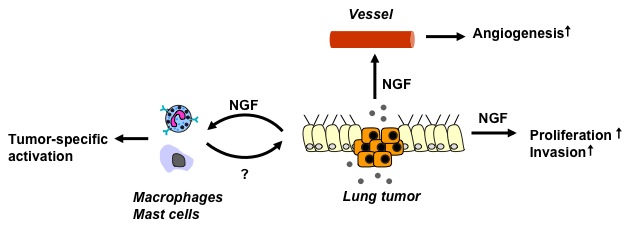
Nerve growth factor (NFG) is a member of the neurotrophin growth factor family. These proteins were first discovered as essential growth and survival factors in the nervous system but recent findings also reveal multiple biological functions in other cell systems. So NGF has been described to support activation and survival of various immune cells and has proangiogenic activities in endothelial cells. Moreover NGF also support proliferation and repair mechanisms of tissue epithelia and NGF has been recently implicated as a prooncogenic factor in various carcinomas. In carcinomas an intense expression of NGF and its receptor TrkA has been shown to predict high tumorgenity and poor prognosis. In the current project we want to investigate the role of this factor in the progression of bronchial carcinoma. The pathogenic changes involved in lung cancer include hyperplasia and dysplasia of the bronchial epithelium and development of invasive growing carcinoma at a late stage. At this stage tumor growth is accompanied by increased local vascularity and tumor angiogenesis is thought to mainly contribute to cancer pathogenesis. In previous studies we could show that NGF is an autocrine growth factor for murine airway epithelial and epithelial NGF is upregulated during wounding of these cells. Increased NGF expression by epithelial cells mediates epithelial proliferation and wound closure in an autocine fashion but may also act in a paracrine manner to support epithelial growth. In this regard we were able to demonstrate a direct proangiogenic activity of NGF on cultured endothelial cells as well as during NGF overexpression in the mouse lung. Therefore we speculate that NGF also mediates tumor progression in bronchial carcinomas by promoting tumor growth and angiogenesis. This is investigated during in vitro studies of murine lung carcinoma cells as well as in a mouse model of lung carcinoma. In tumor cell lines autocrine NGF expression will be knocked down and tumor proliferation as well as angiogenesis will be compared using NGF+/+ versus NGF-/- cells. Moreover we want to investigate the role of tumor NGF synthesis on lung infiltration of immune cells. It is well known that tumor-associated immune cells can inhibit but also support tumor growth and especially mast cells and a subpopulation of macrophages have been implicated to support tumor angiogenesis. While in allergic reactions the epithelial expression of NGF enhances immune cell infiltration in the lung also tumor-derived NGF may influence a local immune response. Therefore we will compare number and phenotype of tumor-associated immune cells after inoculation of NGF+/+ vs. NGF-/- tumor cells.
|
| Last Updated on Monday, 15 June 2009 08:00 |