

Junior Group - Matthias Lauth

Matthias Lauth, PhD
Institut für Molekularbiologie und Tumorforschung (IMT)
Emil-Mannkopff-Str. 2
35033 Marburg
phone: +49-6421-28 66727
Fax: +49-6421-28 68923
Email: Matthias Lauth
Institut für Molekularbiologie und Tumorforschung (IMT)
Emil-Mannkopff-Str. 2
35033 Marburg
phone: +49-6421-28 66727
Fax: +49-6421-28 68923
Email: Matthias Lauth
Graduate students
phone: -6421-28 65374

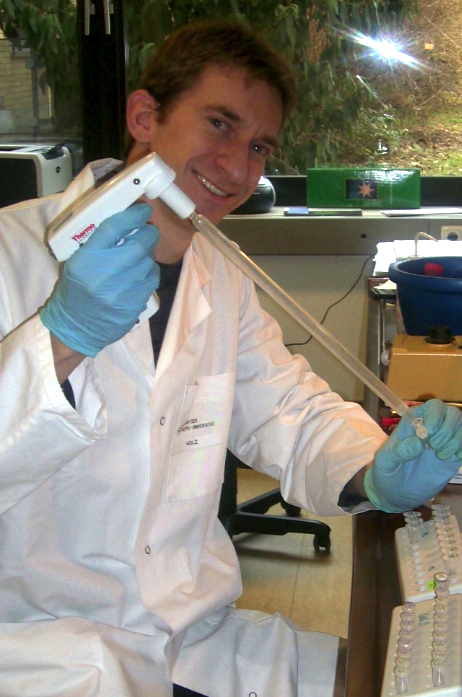
Personal advisory board of V. Rohnalter and P. Holz
Lauth, Buchholz, Fendrich, Konur
| Junior Group - Matthias Lauth |
|
Independent Junior Research Group
-Matthias Lauth- Hedgehog signaling in cancer Overview In the mammalian embryo, approximately a handful of signal transduction pathways are involved in orchestrating the key steps of embryogenesis. One of these instructive cues is represented by the Hedgehog (Hh) signaling pathway, which induces such diverse cellular responses as proliferation, differentiation or neuronal guidance, depending on the biological context [Hooper et al. (2005), Nat Rev Mol Cell Biol 6, 306-317]. Pattern formation in tissues such as the skin, brain and the neural tube, or the developing limbs has been shown to be subject to regulation by Hh signaling. Improper Hh signaling is a major cause of holoprosencephaly, the most common child birth defect. In postnatal life, the Hh pathway is spatially restricted and its proposed role is in the induction of proliferation of adult stem cells, which are required for tissue maintenance and repair [Beachy et al. (2004), Nature 432, 324-331]. Persistent or aberrantly reactivated signaling is associated with hyperproliferative disease and tumor development. It is currently estimated that approximately one third of all cancer deaths are linked to erroneous Hh pathway activation [Lum et al. (2004), Science 304, 1755-1759]. The mammalian Hedgehog pathway: A brief introduction Ectopic activation of the Hedgehog (Hh) signaling pathway has recently been shown to be involved in several malignancies, such as basal cell carcinoma of the skin (BCC), medulloblastoma, rhabdomyosarcoma or cancers of the pancreas, colon, stomach, lung and prostate. Vertebrate organisms possess three Hh proteins (Shh (Sonic Hh), Ihh (Indian Hh), Dhh (Desert Hh)) which all bind to the same receptor, Ptch1. Without ligand stimulation, Ptch1 restrains signaling of the seven-pass transmembrane protein and proto-oncogene Smoothened (Smo). Upon Hh binding, this inhibition is relieved and Smo transduces the signal to the ultimate effectors of the pathway, the zinc-finger transcription factors Gli1, Gli2 and Gli3. With respect to tumor formation, Gli1 and Gli2 are the prime transcriptional effectors involved and constitutive activation of at least one of them is of critical importance for cancer development. Additional pathway members which act between Smo and Gli include negative components such as Suppressor of Fused (Sufu), Rab23 or Ren as well as proteins exerting a positive effect on Hh signaling, such as IFT proteins, Tectonic or MIM/BEG4. Recently an unusual cell organelle, the primary cilium, has been identified as being essential for Hh signaling. Most of the cells of our body harbor one primary cilium on their surface. Primary cilia are non-motile protrusions of the cell’s membrane, held in shape by a microtubular axoneme. Primary cilia function as cellular sensors for chemical or mechanical signals emanating from the environment.  (A) Immunofluorescence picture of fibroblast primary cilia (red, stained with acetylated tubulin antibody); nuclei are DAPI stained (blue). (B) Electron micrograph of a primary cilium (NIH3T3 fibroblast). Our research interests We are pursuing three major lines of research: 1.) Investigating the role of tumor-stromal Hedgehog signaling in pancreatic cancer Pancreatic ductal adenocarcinoma is characterized by a high percentage of non-cancerous stromal cells which surround Hedgehog-ligand producing tumor cells. In this project, we are looking into the functional role of tumor-cell secreted Hedgehog ligands on the tumor cells themselves and on their surrounding normal stromal cells. We are focusing on aspects such as tumor cell migration, survival, differentiation and formation/maintenance of cancer stem cells. Included in this line of research, we are investigating the role of Hh signaling in the activation of fibroblasts (leading to ‘stromal desmoplasia’). Our aim is to apply the acquired information to set up first steps of a targeted therapy for pancreatic cancer. To achieve these goals, we are using state-of-the-art molecular biology and cell culture methodologies as well as mouse cancer models.  Schematic diagram depicting the Hh-mediated crosstalk between Hh-producing tumor cells (blue) and Hh-receiving ‘normal’ stroma cells (red). In turn, Hh-activated stromal fibroblasts provide crucial growth factors to the tumor cells. This crosstalk promotes cancer growth, chemoresistance and metastasis. 2.) Understanding the molecular regulation of HH signal transduction In light of the importance of proper Hh signaling for embryogenesis, it comes as no surprise that Hh signaling is precisely regulated. These control measures are often deregulated in cancer, leading to erroneous Hh pathway activity. As a result, canonical Hh signal transduction (as outlined above) can be affected or so called ‘non-canonical’ signaling events can be seen. These signaling steps can result in GLI activation without using the canonical Hh pathway components. Resulting from this, non-canonical signaling has the capacity to bypass the molecular targets of existing Hh pathway inhibitors, rendering tumor cells resistant - an important clinical issue. We are focusing on Hh control mechanisms imposed by protein kinases, with an emphasis on the Dyrk (Dual specificity tyrosine-regulated kinase) family of kinases. These kinases function independently of Hh receptors and are deregulated in many malignancies. 3.) Interaction (cross-talk) of the HH pathway with novel factors Mammalian signalling pathways are often depicted as linear flows of information. However, this simplistic view does not properly describe the complexity of signalling systems, which can rather be seen as networks of densely connected signaling hubs. In order to better understand the “HH network” we are interested in the cross-talk of HH pathway components with other signalling molecules. In this respect we pursue the identification of novel HH pathway components which might serve as connecting links and integration points with other cellular signalling entities. http://publicationslist.org/matthias.lauthIf you are interested in our group: We are always looking for motivated Bachelor- and Master-students! please contact: matthias.lauth AT IMT.uni-marburg.de |
| Last Updated on Wednesday, 09 January 2013 08:55 |