
TP13: Control of inflammation induced gene expression by cell cycle dependent kinases of the IL-1 and TNF pathway

Prof Dr. Michael Kracht
Frankfurter Str. 107
35392 Giessen
Tel.: (49) 0641 - 99 47600
Fax: (49) 0641 - 99 47619
Email: Michael Kracht
homepage M. Kracht
Graduate student:

Katja Handschick
| TP13: Control of inflammation induced gene expression by cell cycle dependent kinases of the IL-1 and TNF pathway |
|
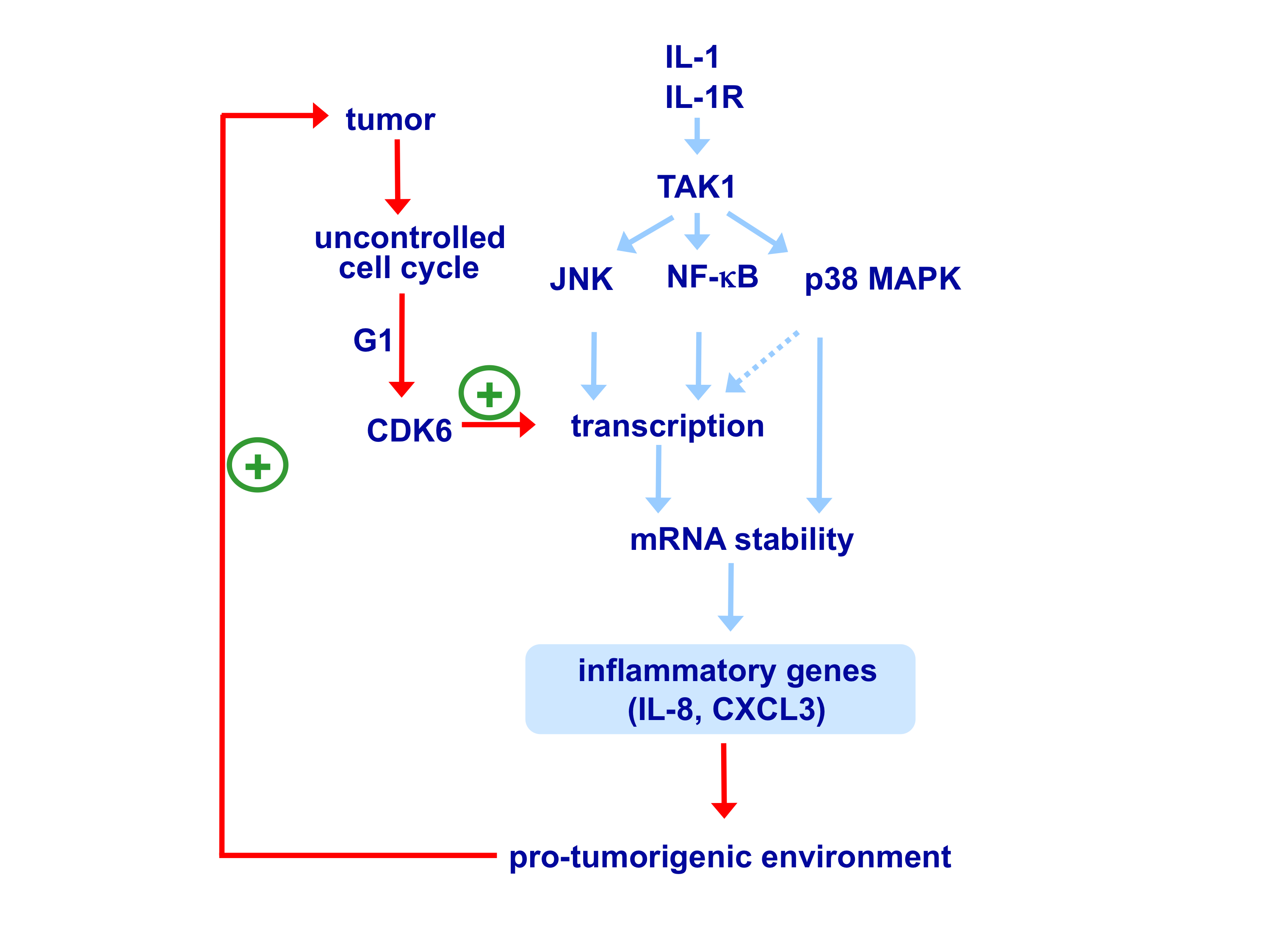
The potent proinflammatory cytokine Interleukin-1 (IL-1) is produced at sites of tumors by tumor-associated macrophages but also by tumor cells and by endothelial or epithelial stroma cells. Depending on the cellular context, IL-1 can have tumor-promoting but also tumor-suppressing effects. The underlying molecular mechanisms are not clear. Gene amplification, overexpression, loss of CDK inhibitors or overexpression of D-type cyclins activates interphase kinases (CDK2, CDK4, CDK6) which promote uncontrolled tumor cell proliferation. Hence, small molecules directed against CDK4/6 (e.g. PD0293391) are being tested for treatment of several human tumors. Our unpublished data reveal that CDK6 specifically affects tumor cell-associated inflammatory gene expression unravelling an unexpected function of this kinase whose contribution to tumor pathology is unknown. These results have widespread biological implications as they define a novel cross talk mechanism between cytokine signaling and cell cycle. Accordingly, aberrant CDK6 expression or activation that is frequently observed in human tumors contributes through NF-κB to chronic inflammation and neoplasia. We postulate that interphase kinases such as CDK4 or CDK6 exploite the IL-1 signaling network to establish a pro-tumorigenic microenvironment by affecting signaling “thresholds” and feedback loops in the NF-κB and possibly other pathways. With the help of LOEWE colleagues we aim to systematically characterize and identify the molecular links between activated interphase kinases, their regulators and major IL-1-induced signaling pathways and assess the relevance of these observations for tumors by establishing appropriate genetic models in mice.
|
| Last Updated on Tuesday, 07 December 2010 11:42 |