
C2: Significance of ATP-dependent chromatin remodeler for the NFkB action

Prof. Dr. Alexander Brehm
Institut für Molekularbiologie und Tumorforschung
Emil-Mannkopff-Str. 2
35033 Marburg
Institut für Molekularbiologie und Tumorforschung
Emil-Mannkopff-Str. 2
35033 Marburg
Cooperation within LOEWE
B4 - Suske
C4 - U. Bauer
C1 - Renkawitz
C5 - S. Bauer
A5 - Bals
C4 - U. Bauer
C1 - Renkawitz
C5 - S. Bauer
A5 - Bals
Graduate student

Nina Neuendorff
email: N. Neuendorff
phone: 06421 28 66368
phone: 06421 28 66368
Personal advisory board: Brehm, S. Bauer, Konur
| C2: Significance of ATP-dependent chromatin remodeler for the NFkB action |
|
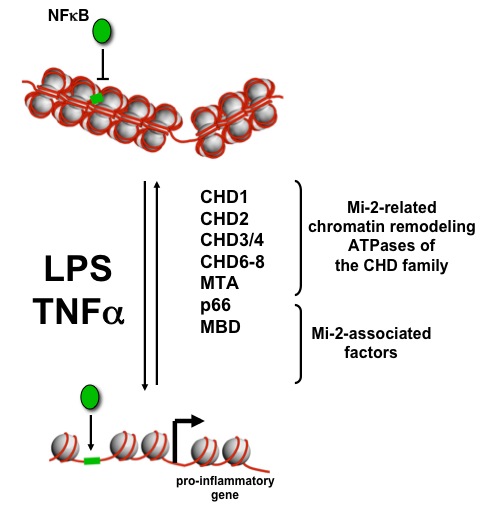
The ATP-dependent chromatin remodeler Mi-2 has recently been demonstrated to play a role during the activation of pro- inflammatory genes. It is not known if Mi-2 related enzymes of the CHD family or Mi-2 associated proteins also contribute to the activation of the pro-inflammatory genes. We will investigate, how RNA interference-mediated depletion of these factors influences the activation of pro-inflammatory genes. We will use LPS and TNFα and stimulate cells via Toll-like receptors (TLRs). First, we will determine the effects on expression of selected established pro-inflammatory genes. At a later stage, we will extend our study to the genomewide level by using microarray technology. Theses analysis will allow us to define the roles of CHD ATPases and Mi-2 associated proteins during inflammation.
Figure legend: Stimulation of cells by LPS or TNFα results in the activation of the NFkB transcription factor. NFkB binds to regulatory regions of pro-inflammatory genes and activates their transcription. Gene activation is accompanied by significant changes in chromatin structure which facilitates binding of NFkB and other transcription factors and transcription itself. The ATP-dependent chromatin remodeler Mi-2 (CHD4) has been implicated in this process. However, the roles of other CHD family members and the influence Mi-2 associated factors has not been explored. |
| Last Updated on Thursday, 18 June 2009 11:48 |